The Art of Flintwork: A Wiltshire Building Tradition
Flint is one of Wiltshire's most distinctive — and most demanding — building materials. Here's how we use it in contemporary architecture.
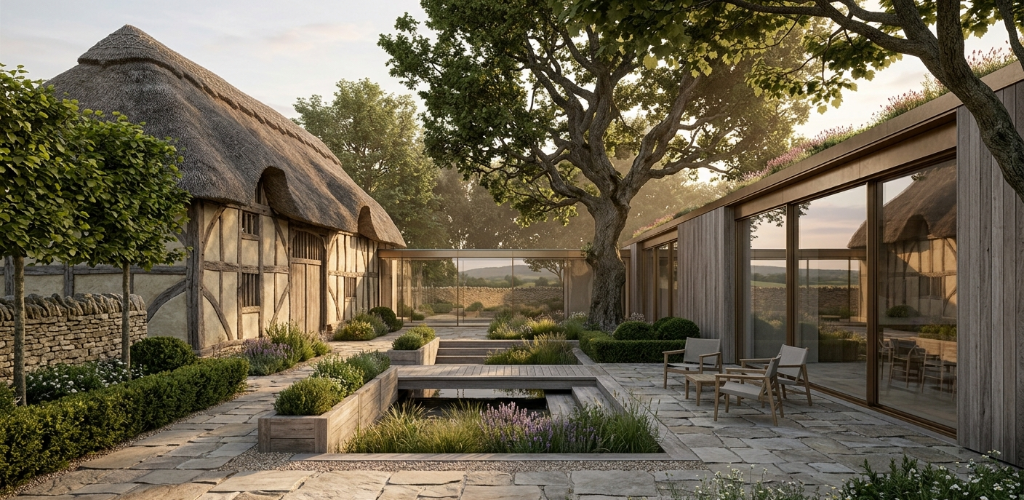
There is no material more evocative of the chalk downland villages of Wiltshire than flint. Dark, glassy, and ancient, it has been used to build walls, churches, and barns across the county for over a thousand years. Drive through the villages around Marlborough — Burbage, Easton Royal, Wilcot, Milton Lilbourne — and the dominant walling material is flint, set into pale lime mortar, often combined with brick dressings around windows, doors, and quoins.
Working with flint is one of the most rewarding — and most technically demanding — challenges in residential architecture. Here's how we approach it.
What Is Flint?
Flint is a microcrystalline quartz formed within chalk deposits during the Cretaceous period. As the chalk has eroded over millennia, the harder flint nodules have been released and concentrated in the soil — which is why they are so abundant across the Wiltshire downland. The nodules vary in size from pebbles to footballs, and their exterior is typically covered in a white chalky cortex that conceals the dark interior.
The colour of freshly knapped flint is extraordinary — a deep, near-black with blue and grey variations and an almost metallic sheen. Weathered flint, as it appears in old walls, softens to a warm grey-brown that sits beautifully against the pale mortar and the surrounding chalk landscape. No two flints are identical, and the variation across a wall is part of its particular quality.
Knapped and Squared Flint
The traditional craft of working flint is called knapping — striking the nodule with a hammer to break it and reveal the dark, glassy interior. A skilled flint-knapper can produce squared faces, known as "squared flint" or "flushwork," which can be laid in regular courses to produce walls of extraordinary precision and beauty.
Flushwork — where knapped flint and dressed stone are set flush to the same plane, creating patterns of dark and light — reached its highest expression in the late medieval period, particularly in East Anglia and the chalk counties of southern England. In Wiltshire, the technique appears in many of the finer church towers and manor houses, and it remains a benchmark for the quality of flintwork that can be achieved.
In contemporary work, knapped flint is typically set in a random pattern rather than coursed, which produces a more textured, organic surface that reads as both crafted and natural. The choice between coursed and random flintwork is a design decision that should respond to the character of the surrounding buildings and the specific quality of the wall being built.
Cob and Field Flint
Not all flint walls use knapped flint. Many of the older agricultural buildings across Wiltshire use "field flint" — unworked nodules as they come from the field, set in thick lime mortar. These walls are rougher, more textural, and more immediately connected to the landscape from which the material was drawn. They are the walls of barns, byres, and boundary walls, and their character is entirely distinct from the finer work of village houses and churches.
We often specify field flint for garden walls, outbuildings, and landscape elements where the rougher, more agricultural character is appropriate. The contrast between a field flint garden wall and a more formally detailed building can be enormously effective.
The Mortar Question
Flint is only as good as the mortar it is set in. The traditional mortar for flintwork is lime mortar — a mix of slaked lime and sharp sand that is breathable, flexible, and slightly softer than the flint itself. Lime mortar allows the wall to move and breathe, accommodating the subtle settlement and moisture movement that occur over decades without cracking.
Modern cement mortars are entirely inappropriate for flintwork. Cement is harder and less breathable than the flint, which means that moisture entering the wall (through driving rain or condensation) cannot escape through the mortar joints. Over time, this traps moisture behind the flint faces, leading to spalling — the flint surface flakes and pops off as moisture freezes and expands. Cement mortar also creates a harsher, more uniform appearance that diminishes the character of the wall.
We use lime mortar exclusively for flintwork, and we work with specialist lime mortar suppliers and flint-knappers who understand the material and its particular requirements.
Flint in Contemporary Architecture
Using flint in a contemporary building doesn't mean reproducing a medieval wall. It means understanding the material well enough to use it in a way that is clearly of its own time. Some of the most successful contemporary flint buildings use the material in panels — framed by steel, timber, or glazing — that acknowledge the flint as a specific, locally sourced material without pretending that the building is itself centuries old.
A flint panel set within a dark steel frame, for example, reads as a deliberate architectural gesture: the ancient material presented as if in a museum case, its texture and colour allowed to speak without the surrounding construction competing with it. This approach can be particularly effective in extensions to historic buildings, where the contrast between old and new is part of the design intent.
Flint and Insulation
One of the technical challenges of flint is its poor thermal performance. A traditional solid flint wall, typically 450–600mm thick, has a U-value of around 1.7–2.0 W/m²K — well below modern standards. This means that flint walls in extensions or conversions almost always require additional insulation, either internally (with insulated plasterboard or wood-fibre boards) or externally (with insulated render systems).
Internal insulation is usually preferred for flint walls, as it preserves the external character of the wall and allows the flint to be seen. However, internal insulation must be detailed carefully to avoid interstitial condensation — moisture that condenses within the wall where warm, humid internal air meets a cold surface. We use breathable insulation systems (wood fibre, cork, or mineral wool with vapour-permeable membranes) for all flint wall retrofits.
The Craft
Flintwork is a craft that cannot be rushed. A skilled flint waller works slowly, selecting each nodule, orienting it for the best face, and bedding it into mortar with care. The quality of the finished wall is visible in the consistency of the joints, the selection and orientation of the flints, and the overall rhythm of the surface. Poor flintwork — hastily laid, with inconsistent joints and poorly selected flints — is immediately apparent and diminishes the whole building.
We work with a small number of specialist flint-knappers and wallers across Wiltshire and the wider South, and we always recommend that flintwork be undertaken by craftspeople with specific experience of the material. The cost is higher than for ordinary brickwork, but the quality and durability of the result justify the investment.
If you have a property with flint walls, or a project where flint is the appropriate material, we would be delighted to discuss it. Get in touch to arrange a consultation at our Marlborough studio. You can also see how we work with traditional materials in projects like Lower Lane and Lechlade Barn.