Landscape Architecture in the Vale of Pewsey: Designing with the Downland
In a protected chalk landscape like the Vale of Pewsey, the garden is never separate from the wider landscape. Here's how we design them together.
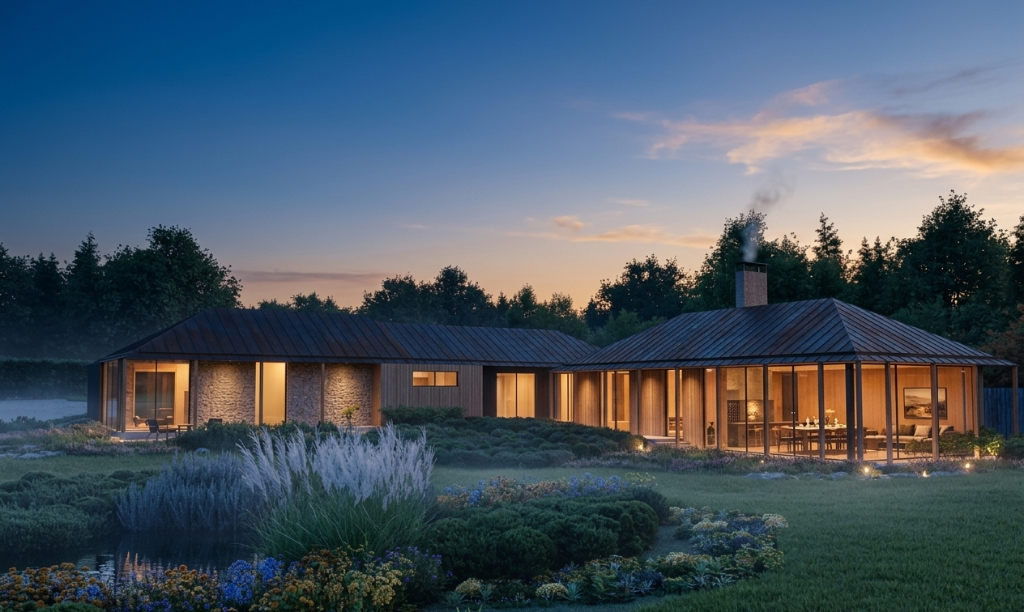
In a landscape as open and as protected as the Vale of Pewsey, the boundary between garden and countryside is rarely a hard line. The fields, the hedgerows, the chalk downland, and the sky are all present in every view from every property — and a garden that turns its back on that wider landscape, treating itself as a separate enclosed realm, will always feel less than it could be.
Good landscape architecture in the Vale of Pewsey is about continuity. It is about designing gardens that extend the character of the surrounding landscape into the immediate setting of the house, creating a gradient between the cultivated and the natural that enriches both. Here's how we approach it.
Start with the Wider Landscape
Before any garden design work begins, we study the wider landscape. What are the field patterns? Where are the hedgerows and the veteran trees? What are the soil conditions — and in the Vale of Pewsey, that almost always means chalk, which has specific implications for what will grow and how. What are the views — both into and out of the site? Where does the sun rise and set, and how does the light change through the seasons?
This analysis informs every subsequent decision. A garden in the Vale of Pewsey that ignores the surrounding chalk downland — that plants a suburban lawn and a border of exotic shrubs where a wildflower meadow and native hedgerow would be appropriate — is a missed opportunity. The best gardens here are those that feel as though they have grown from the landscape, not been imposed upon it.
The Chalk Soil
Chalk soil is alkaline, free-draining, and often shallow. It is not the easiest soil to garden — many familiar garden plants, which prefer neutral or slightly acid soils, will struggle. But chalk soil supports a remarkable community of native plants: orchids, scabious, knapweed, wild marjoram, bird's-foot trefoil, and dozens of grasses that produce the characteristic downland flora of the Wiltshire countryside.
A garden on chalk can lean into this. Rather than fighting the soil with imported topsoil and lime-hating plants, we design planting schemes that celebrate the chalk flora — wildflower meadows, native shrub borders, and drifts of perennials that thrive in alkaline conditions. The result is a garden that is genuinely of its place, that supports local biodiversity, and that requires less irrigation and fewer inputs than a conventional garden.
Native Planting and Biodiversity
In a landscape as ecologically rich as the North Wessex Downs, the garden has a role to play beyond its aesthetic function. Well-designed native planting can provide habitat for pollinators, food for birds, and corridors for the movement of wildlife across the wider landscape. In our Egbury Road project, we designed a planting scheme that achieved a 40% biodiversity net gain — a measurable improvement in the ecological value of the site compared to its previous condition.
Native hedgerows — hawthorn, blackthorn, field maple, dogwood, hazel — are the backbone of a Wiltshire garden. They provide structure, screening, and habitat, and they connect the garden to the field boundaries of the surrounding agricultural landscape. Mixed native hedges also provide seasonal interest — hawthorn blossom in spring, rosehips and sloes in autumn — that no exotic hedge can match.
Wildflower meadows are another powerful tool. A meadow, whether established from seed or from plug plants, transforms a lawn into a dynamic, seasonal landscape that hums with life through the summer months. In the Vale of Pewsey, where the chalk downland flora is part of the regional character, a wildflower meadow connects the garden directly to the landscape beyond.
Structure and Enclosure
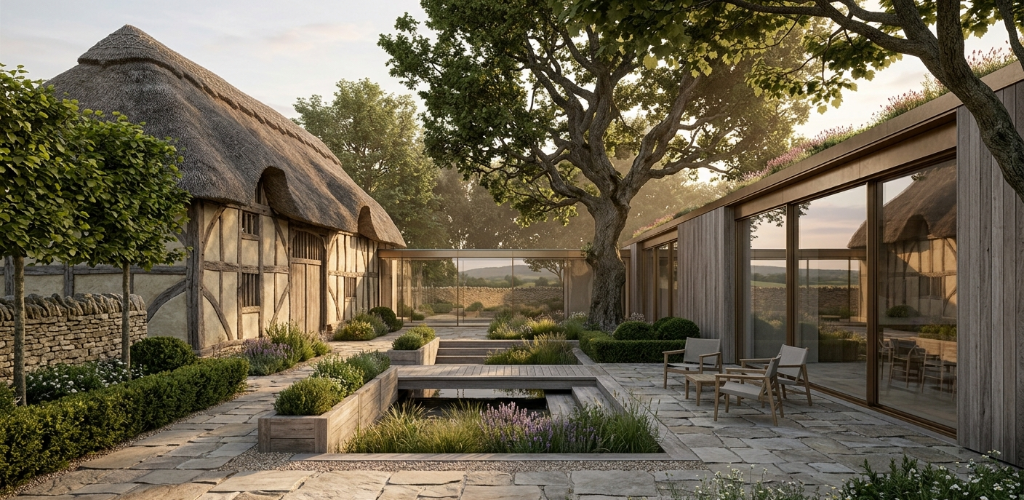
Even in an open landscape, some enclosure is needed. Gardens need structure — walls, hedges, and defined spaces — to feel intentional and to provide shelter. In the Vale of Pewsey, the materials of that structure should draw from the local vernacular: sarsen stone walls, flint and brick boundary walls, native hedgerows.
The degree of enclosure is a design decision that responds to the specific site. A garden that is too enclosed — with high walls and dense hedges on all sides — will feel disconnected from the landscape that gives the Vale its character. One that is too open — with no enclosure at all — will feel exposed and unstructured. The right balance varies, but it usually involves a gradient: more enclosure close to the house, opening out toward the boundaries where the garden meets the wider countryside.
Water in the Garden
Water features — whether a formal reflecting pool, a natural pond, or a rill — can transform a garden. In the Vale of Pewsey, where the chalk landscape is fundamentally dry, water has a particular preciousness that makes it all the more powerful. A still pool, reflecting the sky, is a remarkable thing in a dry landscape.
In our Butser Farm Masterplan, a central natural pond anchors the development around a genuinely ecological water feature — providing habitat for amphibians and dragonflies, managing surface water, and creating a focal point that connects the development to the wider landscape. The same principles apply at the domestic scale: a pond that is designed for biodiversity, with gently sloping margins and native marginal planting, is both beautiful and functional.
The Garden Through the Year
A garden in the Vale of Pewsey is experienced through the seasons in a way that is shaped by the chalk landscape. In spring, the downland comes alive with cowslips and early orchids. In summer, the meadows are at their peak — a riot of colour and insect life. In autumn, the hedgerows are heavy with fruit, and the light takes on a particular quality as it lower across the open landscape. In winter, the structure of the garden — the walls, the hedges, the bare trees — is revealed, and the views to the surrounding downland are at their clearest.
Designing for all four seasons is essential. A garden that peaks in June and offers nothing in January is a garden that is only half-designed. We always plan planting schemes with the winter structure in mind, ensuring that the garden has interest and beauty through every month of the year.
Integration with the Architecture
The best gardens are designed alongside the architecture, not as an afterthought. The relationship between inside and outside, the views from key rooms, the way the building meets the ground — these are decisions that should be made together, by the architect and the landscape designer working in collaboration.
In our practice, landscape design is integrated into the architectural process from the earliest stages. We don't think of the building and the garden as separate things; we think of them as a single composition, each informing the other. This is particularly important in a landscape as sensitive as the Vale of Pewsey, where the building's relationship to the land is the most important design variable of all.
Our Willowbank project, in the South Downs National Park, demonstrates the same principle in a similar protected landscape — a building designed from the outset to integrate with its landscape setting.
If you have a property in the Vale of Pewsey and would like to explore how landscape architecture might enhance it, we would be delighted to discuss it. Get in touch to arrange a consultation at our Marlborough studio.