Chalk Stream Architecture: Building Beside Wiltshire's Living Rivers
Wiltshire's chalk streams are among the rarest habitats on Earth. Building beside them demands exceptional care. Here's how we approach it.

There are perhaps 200 true chalk streams in the world, and most of them are in England. Wiltshire is at the heart of their range — the River Avon, the River Wylye, the River Nadder, the River Ebble, the River Bourne, and the Hampshire Test all flow through or along the county's chalk downland, fed by the aquifers that lie beneath. These are extraordinary rivers: crystal-clear, naturally mineral-rich, and supporting a diversity of plant and animal life that makes them internationally significant.
Building beside a chalk stream is a privilege — and a serious responsibility. These are protected landscapes, with planning controls, ecological designations, and environmental considerations that demand genuine expertise. Here's how we think about it.
What Makes Chalk Streams Special
Chalk streams are fed not by surface runoff but by groundwater — rainwater that has percolated through the chalk bedrock and emerges, filtered and mineral-rich, as springs along the valley floors. This gives them several distinctive characteristics.
Clarity. Chalk stream water is extraordinarily clear, because it has been filtered through many metres of chalk. The riverbed is visible in detail, and the light that reaches it supports a rich community of aquatic plants — water crowfoot, starwort, water mint — that in turn support insects, fish, and birds.
Stable temperature. Because the groundwater emerges at a relatively constant temperature (around 10°C year-round), chalk streams are thermally stable. They don't freeze in winter or warm dramatically in summer, which makes them particularly important refuges for fish and other aquatic life.
Mineral richness. The chalk through which the water has passed dissolves into it, providing calcium and other minerals that support a distinctive flora and fauna. The plant communities of chalk streams are found nowhere else.
These characteristics make chalk streams among the most biodiverse habitats in the UK. They support Atlantic salmon, brown trout, brook lamprey, water voles, otters, kingfishers, and a wide range of invertebrates. They are, quite simply, irreplaceable.
The Planning and Environmental Framework
Chalk streams in Wiltshire are protected through multiple overlapping designations. Many are Sites of Special Scientific Interest (SSSIs), reflecting their national ecological importance. Some are within Special Areas of Conservation (SACs), a European-level designation that provides additional protection. Most flow through Areas of Outstanding Natural Beauty or, in the case of the Hampshire Test, the North Wessex Downs.
The Environment Agency is a statutory consultee on planning applications affecting chalk streams, and their focus is on water quality, flow rates, and the protection of the river ecosystem. The local planning authority (Wiltshire Council, or the relevant National Park authority) will apply its own policies on riverside development, which typically emphasise the protection of the watercourse, the avoidance of pollution, and the maintenance of natural river processes.
A flood risk assessment is almost always required for development near a chalk stream. While chalk streams are relatively stable in flow, they do flood — particularly in wet winters when the aquifers are full and the springs are flowing strongly. Any development must be designed to accommodate flood events without increasing flood risk elsewhere or compromising the ecological integrity of the watercourse.
Setback and Buffer Zones
The most important design principle for chalk stream development is the setback — the distance between the building and the watercourse. A generous setback serves multiple functions: it protects the river from construction impacts and from the ongoing effects of the building (light, noise, runoff), it preserves the riparian corridor of vegetation that is so important to the river's ecology, and it maintains the visual character of the river valley.
We typically recommend a minimum setback of 8–10 metres from the top of the riverbank, with the intervening land managed as a natural riparian buffer — native marginal planting, unmanaged grassland, and a genuine wildlife corridor connecting the river to its floodplain. This buffer is not just a planning requirement; it is a design opportunity. A building that sits within a generous, naturalistically planted landscape, with the river visible through a frame of native trees, gains a quality that no building crammed up to the water's edge can achieve.
Water Quality and Surface Water Management
Chalk streams are acutely sensitive to water quality. Runoff from buildings, driveways, and gardens — carrying oil, silt, fertilisers, and other pollutants — can degrade the river ecosystem. Any development near a chalk stream must manage surface water on-site, using sustainable drainage systems (SuDS) that filter and attenuate runoff before it reaches the watercourse.
SuDS for chalk stream sites typically include permeable paving, swales (shallow vegetated channels that slow and filter runoff), and detention basins that hold water during heavy rain and release it slowly. The goal is that no untreated surface water reaches the river — that every drop is filtered through vegetation and soil before it enters the watercourse.
Sewage and wastewater treatment is another critical consideration. Properties near chalk streams must not discharge effluent into the river or into the groundwater that feeds it. Where mains drainage is not available, we specify high-performance package treatment plants with tertiary treatment (often reed-bed systems) that produce effluent of a quality suitable for discharge to land, not to water.
Light and the River
Chalk streams are sensitive to artificial light, which can disrupt the behaviour of fish, invertebrates, and the bats and birds that feed over the water. Development near chalk streams should minimise light spill — using directional, low-intensity external lighting, and avoiding the illumination of the watercourse itself.
This is not just an ecological consideration; it is a design opportunity. A building beside a chalk stream, lit only by low, warm, carefully directed light, takes on a particular character — quieter, more intimate, more connected to the natural rhythms of day and night. The river, unlit, remains a dark, audible presence at the edge of the garden.
Materials and the Riparian Setting
The material palette for a building beside a chalk stream should draw from the river and its valley. The chalk itself, of course, is the underlying geology — but it is too soft and porous for most external uses. More appropriate are the materials that characterise the river valleys: sarsen stone, flint, brick, timber, and the willow and alder that grow along the banks.
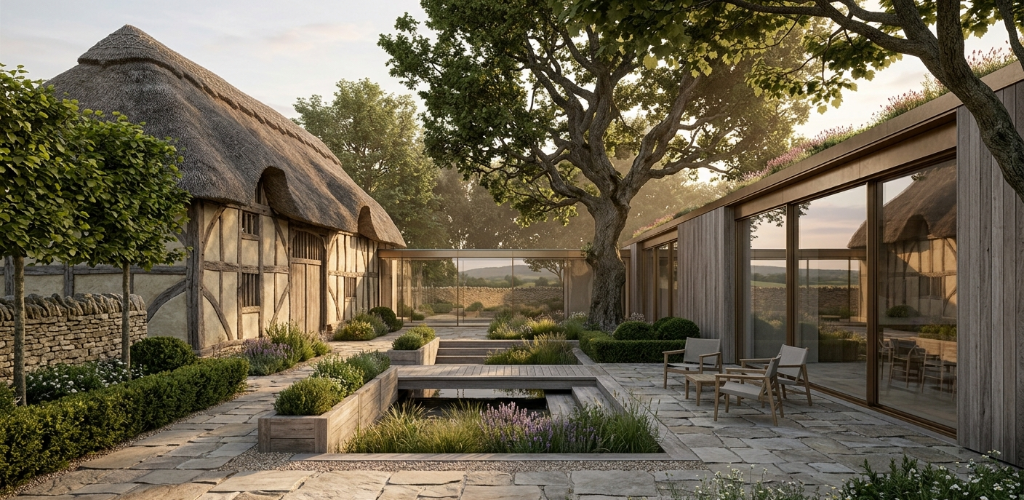
Weathered timber is particularly appropriate — silvered larch or cedar, or dark-stained vertical boarding that reads as part of the riverside vegetation. Combined with a green or sedum roof, a timber-clad building can settle into its riparian setting almost as if it has grown there.
Water itself can be brought into the design. Our Hyde Street Terrace Poolhouse in Winchester demonstrates how water — in that case, a swimming pool — can be used as a design element that connects a building to the presence of water in the wider landscape. While not a chalk stream project, the principle of designing with water as a positive, animating element rather than a constraint is the same.
The Sound of Water
One of the great pleasures of building beside a chalk stream is the sound of water. Chalk streams are not roaring rivers — they are quiet, gentle, and their sound is more a murmur than a rush. But it is there, constantly, and it changes the acoustic character of a site in a way that is immediately apparent.
We design buildings beside chalk streams to capture this sound — opening the building toward the river, positioning windows and terraces to engage with the water, and using materials (stone, timber, glass) that don't compete acoustically with the river's voice. A building that turns a blank, hard wall toward the river reflects sound back and diminishes the experience; one that opens to the water, with soft, absorbent surfaces, amplifies it.
A Responsibility
Building beside a chalk stream is not a right but a responsibility. These are among the rarest and most fragile habitats on Earth, and any development that affects them must be undertaken with care, expertise, and a genuine commitment to their protection.
When done well — with a deep understanding of the river, a generous setback, careful water management, and a building that responds to its riparian setting — a chalk stream project can be among the most rewarding a residential architect can undertake. The presence of the water, the quality of the light, and the biodiversity of the setting create conditions for architecture of real distinction.
If you have a property beside a chalk stream in Wiltshire and would like to discuss its potential, we would be delighted to talk. Get in touch to arrange a consultation at our Marlborough studio.