The Vale of Pewsey: Designing a Home in Rural Wiltshire
The Vale of Pewsey is one of Wiltshire's most beautiful — and most protected — landscapes. Here's what it means to design a home here.
If you drive west from Marlborough on the A4, the landscape opens dramatically as you crest the chalk ridge. Below you, stretching to the horizon, lies the Vale of Pewsey — one of England's finest rural landscapes, shaped by centuries of farming, bounded by the chalk escarpments of the Marlborough Downs to the north and Salisbury Plain to the south, and dotted with villages of extraordinary character.
Designing a home in the Vale of Pewsey is one of the most rewarding briefs a residential architect in Wiltshire can receive — and one of the most demanding. The planning environment is rigorous, the landscape designation is protective, and the expectations of design quality are high. But the opportunity — to create a building that contributes positively to one of England's most beautiful rural landscapes — is exceptional.
The Planning Context
The Vale of Pewsey sits entirely within the North Wessex Downs Area of Outstanding Natural Beauty. This means that national planning policy applies a strong presumption against development that would harm the landscape's special qualities, and that Permitted Development rights — for extensions, outbuildings, and alterations — are significantly more restricted than in ordinary residential areas.
In practice, this means that almost any external works to a property in the Vale of Pewsey will require planning permission, and that the design quality of what you propose will be scrutinised carefully. Wiltshire Council's planning officers have deep familiarity with the AONB policies and the specific character of the Pewsey Vale settlements, and they expect applications to demonstrate a genuine understanding of the landscape context.
This is not something to be daunted by. It is something to be embraced. The AONB designation exists precisely to ensure that new development in these landscapes is of a quality that enhances rather than diminishes them — and that is exactly the kind of design challenge that our practice values.
The Character of the Vale Settlements
The villages of the Vale of Pewsey — Pewsey itself, Burbage, Milton Lilbourne, Easton Royal, Wilcot, and others — share a common architectural language rooted in their agricultural history. Thatched or tiled farmhouses, stone and flint cottages, brick Victorian terraces, and the occasional Georgian rectory or manor house define the streetscape. The building materials — sarsen stone, Chilmark limestone, red brick, flint, clay tile — are consistent across the area and derive directly from the local geology.
The settlements are compact — villages that stop abruptly at their edges, giving way to open fields — and the relationship between the buildings and the surrounding landscape is intimate. Wind, light, and the changing seasons are felt keenly in every property. The sky is large.
Designing a new building — or extending an existing one — in one of these villages demands an understanding of these relationships. The massing, the roofscape, the materials, and the connection to the surrounding land must all be considered together. A design that might work perfectly well in a suburban context will almost certainly be inappropriate here.
Rural Sites and Landscape Integration
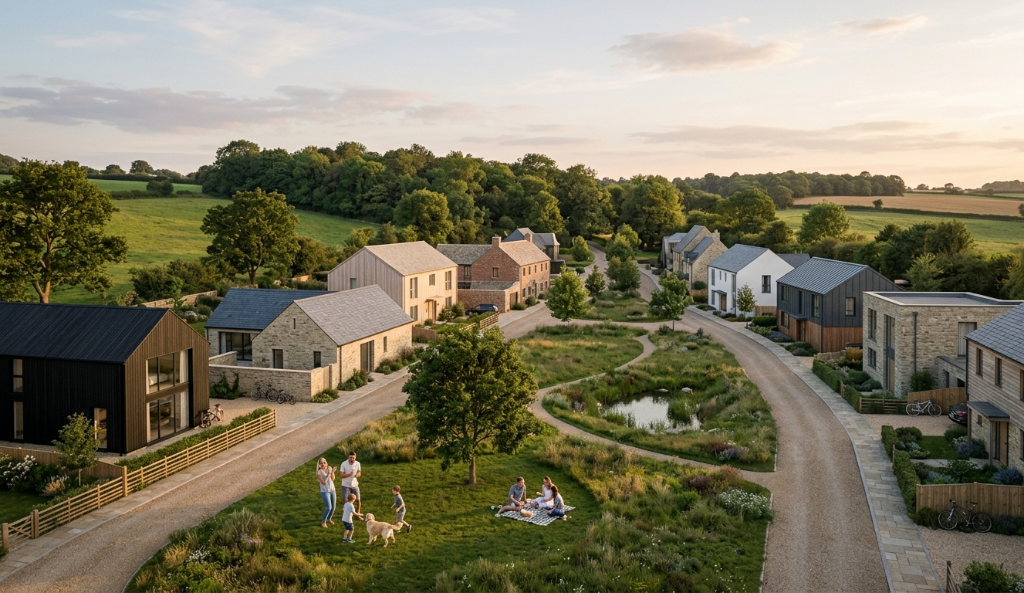
For a new build in the Vale of Pewsey, landscape integration is the most important design variable. The building must sit within the land, not on it. The choice of roof form — steeply pitched and clay-tiled, or more gently pitched in standing seam metal — should reflect the character of the surrounding agricultural buildings and the specific undulations of the site.
We typically conduct a thorough landscape analysis before any design work begins: understanding the topography, the views into and out of the site, the existing vegetation and field patterns, and the relationship of the site to its neighbours. This analysis informs every subsequent decision — where the building sits, how it faces, what materials it uses, and how it meets the ground.
The Agricultural Vernacular
One of the most rewarding design references in the Vale of Pewsey is the agricultural vernacular — the barns, byres, and cart sheds that dot the landscape and give it much of its distinctive character. These buildings are simple in form, honest in material, and entirely without pretension. A timber-framed barn with clay tile hanging, a brick and flint byre with a corrugated iron roof, a stone cart shed open to the fields on one side — these are buildings that have evolved over centuries to serve a practical purpose, and their beauty is in their directness.
Contemporary houses in the Vale can learn from this tradition without imitating it. The simplicity of form, the directness of material, the clarity of the relationship between building and land — these are qualities that belong as much to good contemporary design as to the agricultural tradition. A new house that works with the land rather than against it, that uses materials drawn from the local geology, and that is built to last, can be both unambiguously modern and deeply connected to the place it occupies.
Working with the AONB Policy Framework
The North Wessex Downs AONB Management Plan sets out detailed policies on design quality, landscape character, and development within the AONB. It emphasises the importance of responding to the local landscape character, using appropriate materials, and contributing positively to the special qualities of the area.
We recommend that all clients with sites in the Vale of Pewsey engage with Wiltshire Council through their pre-application advice service before any design work of substance is undertaken. This conversation — between us, the client, and the planning officer — establishes the parameters within which we design, and it ensures that the proposal we develop is aligned with the authority's expectations from the outset.
If you have a property or a site in the Vale of Pewsey and would like to explore what might be possible, we would be delighted to talk. Please do get in touch to arrange a visit or a consultation at our Marlborough studio.