Designing with Corten Steel: Architecture That Ages Beautifully
Weathering steel has become one of the most compelling materials in contemporary residential architecture. Here's why — and how to use it well.
Few materials in contemporary architecture provoke as strong a reaction as corten steel. For some, its rust-orange patina is immediately compelling — warm, textural, and deeply connected to the landscape. For others, it takes time. But once it has weathered to its characteristic amber-brown surface, a corten-clad building becomes almost impossible to imagine in any other material.
We've used corten steel on a number of recent projects, and its appeal — architectural, practical, and philosophical — keeps us returning to it.
What Is Corten Steel?
Corten (a trade name, though now widely used generically) is a weathering steel alloy that, when exposed to the elements, forms a stable, adherent rust layer — the patina — that protects the underlying metal from further corrosion. Unlike ordinary mild steel, which rusts progressively and destructively, corten's oxidation layer is self-limiting. Once formed, it becomes the material's permanent surface finish.
The patina develops over the first two to five years of exposure, shifting through bright orange, deep red, and eventually settling into a rich, complex brown with extraordinary surface variation. No two panels weather identically. The result is a surface that is simultaneously industrial and deeply natural — reminiscent of rock, timber, and autumn landscape.
Why We Use It
It ages well. Most building materials look their best on the day they're completed and deteriorate from there. Corten is different. It looks better at five years than it does at one, and better at twenty than at five. In a Hampshire landscape context — mature trees, damp winters, mellow autumn light — it integrates with exceptional grace.
It requires no maintenance. Once the patina is established, corten requires nothing: no painting, no sealing, no treating. This is not only practical but philosophically aligned with how we think buildings should work — honest materials performing as themselves.
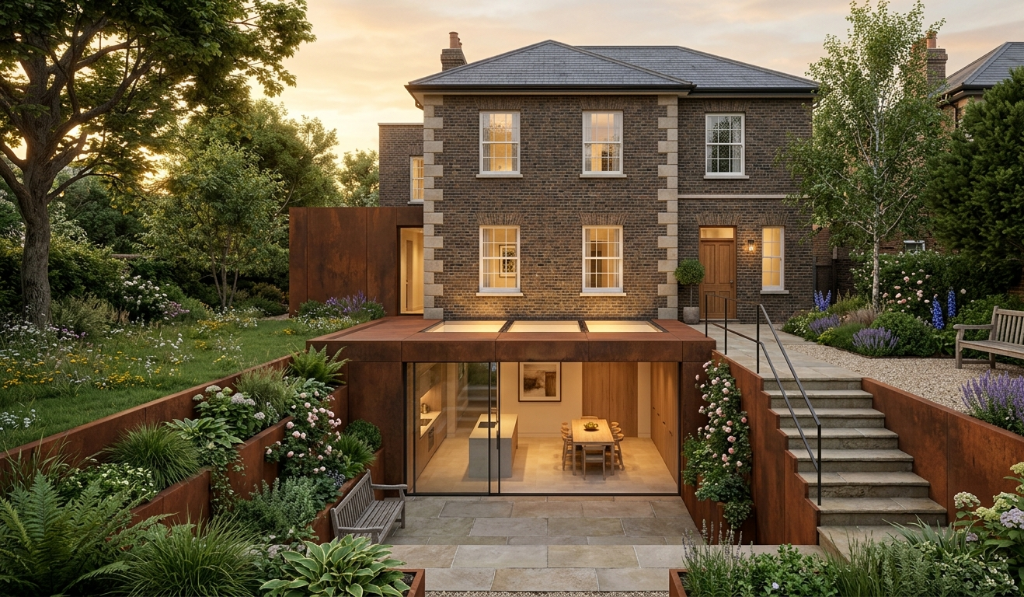
It contrasts beautifully with traditional buildings. At Gulliver's Park in Romsey, we used corten as the cladding material for a contemporary extension to a Georgian townhouse. The warm, textured surface of the steel read as both industrial and organic against the original brick — assertively contemporary without being aggressive.
It works as both enclosure and landscape element. Retaining walls, raised planters, and garden structures in corten create continuity between the architecture and the landscape. The same material that wraps the building can form the terracing, the steps, and the planting beds — unifying the whole composition.
Considerations
Corten is not without practical considerations. The early oxidation phase — typically the first six to eighteen months — produces rust run-off that can stain adjacent materials: pale stone, render, concrete. Detailing must account for this: overhangs, upstand details, and drainage channels prevent run-off reaching surfaces you don't want stained.
In marine environments, corten's corrosion protection is less reliable — the salt-laden air can accelerate oxidation beyond the stable patina threshold. We don't recommend it within a few kilometres of the coast.
And it is heavy — roughly the same as mild steel, which has structural implications for its support system. Corten panels are typically fixed to a steel or timber sub-frame, and this must be designed by a structural engineer.
The Material in Context
Corten sits comfortably alongside a wide palette of other materials. Pale limestone, buff brick, weathered oak, and dark-stained timber are all natural companions. What it doesn't suit is anything too polished or corporate: glazed white render, chrome fixings, and high-gloss surfaces sit uneasily with its rough warmth.
Used well, corten is one of the most powerful materials available to residential architects. Its combination of visual warmth, minimal maintenance, and honest ageing makes it an increasingly important part of our material palette.
If you're considering a project where corten might play a role — an extension, a garden structure, or a new build — get in touch. We'd be happy to discuss how it might work for your specific site.